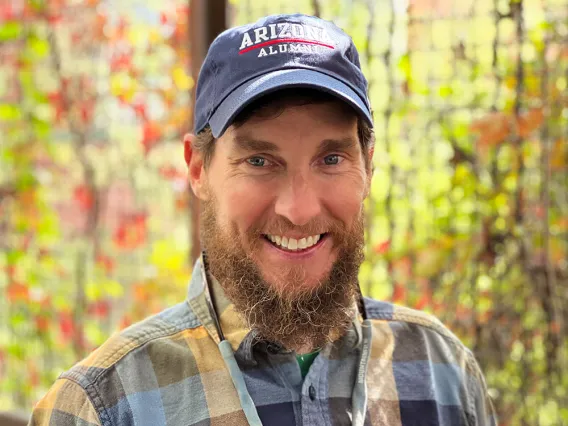
Garrett Smith
Programs
-
Landscape Architecture
-
School of Landscape Architecture and Planning
-
Sustainable Built Environments
Areas of Expertise
-
Advanced statistics and research methods
-
Data science
-
Geospatial analysis
-
Recreation ecology
Degrees
- PhD in Arid Land Resource Sciences, The University of Arizona
- MS in Environmental and Conservation Planning, The University of Arizona
- MA in Graphic Design, Savannah College of Art and Design
- BS in Printing, Georgia Southern University
Biography
Garrett Smith PhD is a recreation ecologist who uses diverse spatial and social (quantitative and qualitative) methods to investigate complex issues surrounding public land management on parks and protected areas. Garrett's research is concentrated around understanding the spatial and social dynamics of recreation and how these impact recreational users, the landscape, wildlife, and the managers that write management plans to address them. Garrett, since being hired at CAPLA, has started to explore how big data and simulation modeling can be used to understand the spatial and temporal flow of recreational users to and across publicly managed landscapes that are adjacent to and/or accessible from large urban areas. To incorporate all the expertise in and around CAPLA, he is also looking to study the importance of access to parks and protected areas to the formation of a sustainable city and how residents of the adjacent cities relate to these areas. Garrett is an avid ultramarathon runner and enjoys running for long periods in the mountains to gain a greater understanding of the issues that he studies and to become fully immersed in a wide array of ecosystems to gain a greater appreciation of how they function.