

A Design Career Well Administered: Robert Miller, Professor of Architecture and Former Director, School of Architecture

“The work that architects have continuously recognized as great architecture are those that not only work well but also produce magic. As schools, we must not lose sight of the quest to make, and teach, this essential core of our mission.”
Robert Miller AIA joined the College of Architecture, Planning and Landscape Architecture in the spring of 2010 as director of the School of Architecture. In his 12 years at CAPLA, Miller has brought not only stability to the school after a long series of interim directors, but also—based on his administrative prowess, foresight and vision—a new era of student success, faculty creative scholarship and research, and industry partnership.
Miller, an award-winning architect, teacher and administrator, will retire from the University of Arizona on January 1, 2023.
In the last two years, Miller was recognized by AIA Arizona for service to the architecture community—receiving the Arizona Architects Medal in 2020 and the Chairman’s Award in 2021. “I have been exceedingly fortunate to have worked with some of the best architects in the state in service to our profession—Arizona has a generous and close-knit community of architects where even the best design firms support each other and contribute significantly to the profession,” he says. “As is often the case, this service has brought its own reward in the form of friendships, learning and shared accomplishments. It was an honor to be welcomed into this community.”

Robert Miller AIA, Professor of Architecture and Former Director, School of Architecture.
Expanding the school’s connections and collaborations to the profession has been central to Miller’s vision for enhancing the educational experience and preparedness of architecture students. “While the academic agenda should not be tailored to the needs of professionals, and although many students will not become a practicing architects, great schools develop their own particular curriculum for producing outstanding architects—otherwise, we are not fulfilling our commitment to the community, the university or the profession, let alone to our students,” he says. “Preparing students for practice is actually what prepares them for other careers, not the other way around. The education of an architect in its highest form is a very special project.”
“It was important to me to have the best architects in the region invested in this school, whether lecturing, teaching or serving as critics. They bring the challenges of practice to the educational mission and serve as a barometer on how we’re doing, which is fundamental to making a great school.”
When Miller first joined the UArizona School of Architecture from Clemson University—where he directed the Clemson Architecture Center in Charleston for a decade after working for 20 years as an adjunct teacher and as principal in his own architectural practice—he reached out to notable architects from the region. “There are a lot of architects in Arizona who care about architectural education—it’s amazing how generous they are,” he says.
Miller’s primary focus upon joining UArizona was to learn how to be a department head—and then to “bring transparency, clarity and administrative efficiency” to the School of Architecture. It was his first assignment in academic administration at this scale, a responsibility ten times the size in both people and dollars of his previous post, and he readily admits to making many mistakes as he learned his craft. He started at CAPLA with the Great Recession and closed with the pandemic—tough bookends. Rather than tackling the challenges of directing a large school from a silo, however, Miller built connections across UArizona, including through the university’s community of department heads.
“I got involved with the HeadsNETWORK at UArizona in my first year, then served on its steering committee, and was invited to become its first executive director in 2019,” he says. With that appointment he developed and led the university’s training program for department heads in their first year. He expanded it from one semester to two and has since been converting it into an e-learning professional education program for all department heads. Even after his official retirement, he will continue developing the program so that “heads who come after me will have ready access to the wisdom of many in the key areas heads face and so future leaders of HeadsNETWORK don’t have to figure out, every year, how to mount professional education for new department heads.”

To hone his skills as administrator Miller also took advantage of the Association of Collegiate Schools of Architecture, participating in conferences and pursuing conversations with other program leaders that led to tight relationships with several architecture school directors across the nation, including Arizona. “The importance of our connection to the other two schools of architecture in Arizona is not to be overlooked,” he says. “Our faculty undertake research and projects together and share reviewers. Administrators support each other and confer on common issues. Our unique triad of educational approaches coupled with the particular sensibilities of Arizona architects forms a distinct and inimitable culture.”
Given his focus on industry partnerships and relationship-building among administrators, it’s no surprise that Miller was elected president of local and then state AIA chapters. “A school director is a great platform for reaching the wider community of architects,” he says. “It was a highly enjoyable run, expanding our access to professional resources while building ties and increasing the school’s visibility and employment pipeline for students.”
Among his most significant accomplishments was working with former Dean Roger Schluntz at the University of New Mexico from 2017 to 2019 to draft a template resolution in opposition to the proposed border wall based on environmental and sustainability issues. Ultimately, AIA chapters across the four border states adapted and adopted the resolution, including all four AIA components in Arizona. Miller then personally presented the resolution to Arizona’s congressional representatives. “While this response to national events felt important at the time,” he says, “the more important impact was probably to shift the tenor of Arizona’s AIA advocacy: we now take a stand on important design and built environment issues, including controversial ones, where we might not have before.”
If the statewide architecture organization has grown an activist slant, is the future of design education likewise more activist in nature?
“The tremendous amount of change that has influenced architectural education in the past five years—social equity, racial equality and the remote work practices imposed by the pandemic—have all been critical for the advancement of the academy and the profession. It has been revolutionary,” says Miller. “These changes have been more cultural than methodical and I think the jury is out on whether they have improved our work. At the end of the day, an architect collaborates with a group of people to design a building that is rooted in a place. The architect then walks away and what has been created takes on a life of its own—a long life. Is it environmentally responsible? Does it bring joy? Does is serve well its many constituents? Does it advance the science and art of design practice? The work that architects have continuously recognized as great architecture are those that not only work well but also produce magic. As schools, we must not lose sight of the quest to make, and teach, this essential core of our mission.”
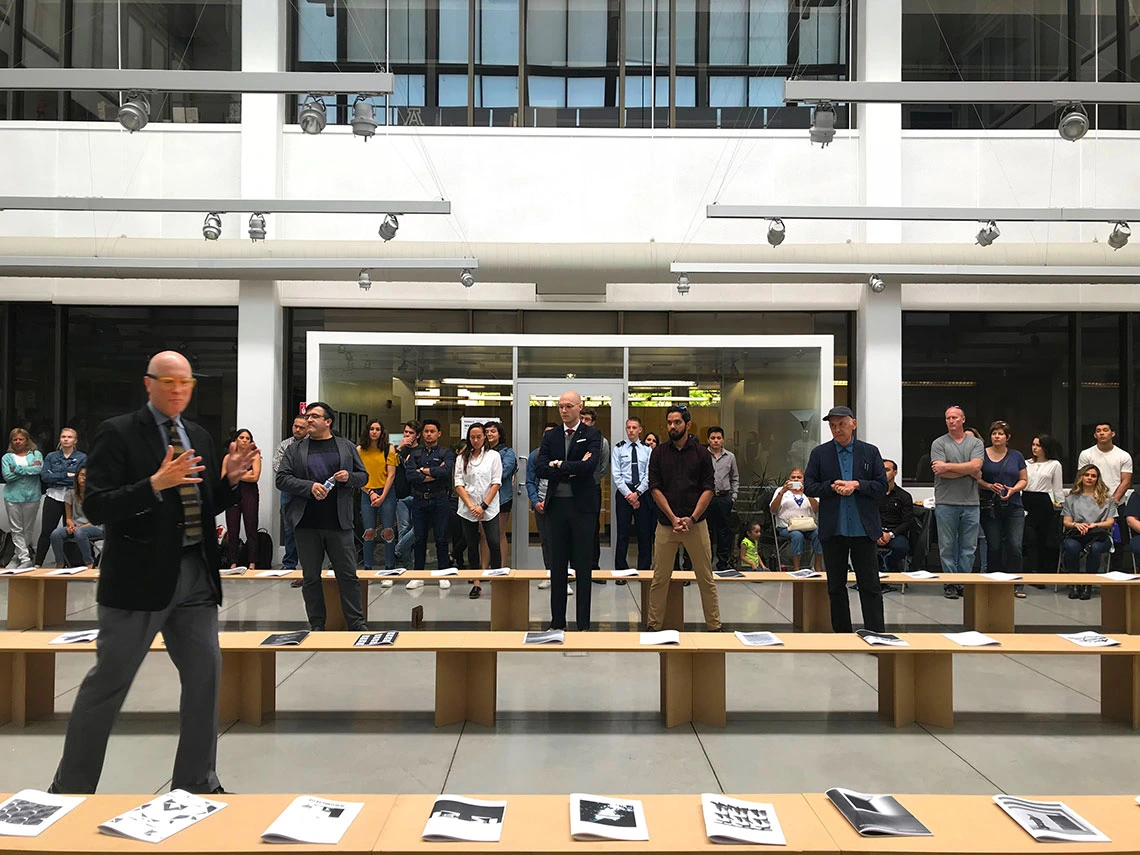
School of Architecture Director Robert Miller provides feedback on Foundation Studio projects in CAPLA's Sundt Gallery. Photo courtesy Robert Miller.
Miller sees the important cultural aspects of the academy and the profession as largely distinct from the discipline’s responsibility to advance a significant built environment. “At the top of the list, as we all know, is to eliminate negative impacts on the environment,” he says. “The built environment, which through construction and operation is responsible for some 45% of greenhouse gas emissions, has to be revolutionized if we are to keep the planet habitable. This is absolutely essential. There is a lot of experimentation and innovation as firms restructure how they work and what they do. It’s a fascinating time and we are witnessing real changes in hierarchies and practices.”
If the future of design ties into Miller’s pursuits beyond retirement, he’s not yet ready to sketch that path.
“People who know me won’t be surprised that I’ve been strategic in planning my career, which has now spanned 50 years—or longer, if you consider that I decided to become an architect in seventh grade,” he says. “But other than committing to retire, I don’t want to plan retirement itself. I’d like a period of my life that is a spontaneous, with more discovery and experimentation. My plan, therefore, is not to plan, but to have this other kind of space where quality and being in the moment take priority over planning and implementation.”
Even here, Miller concedes his dreams: “Reading (slowly) Proust’s In Search of Lost Time or writing a book about the definition of architecture are things I’ve always wanted to do—and oh, I’m dying to try my hand at writing and illustrating classic children’s books.”
“But no,” he concludes. “I’m not going to plan.”
Read our previous profile of Robert Miller, support the School of Architecture with a donation or connect with us to learn how you can impact architecture and other students at CAPLA.


