

Understanding the Past to Design a Better Future: Lisa Schrenk, Associate Professor of Architectural History
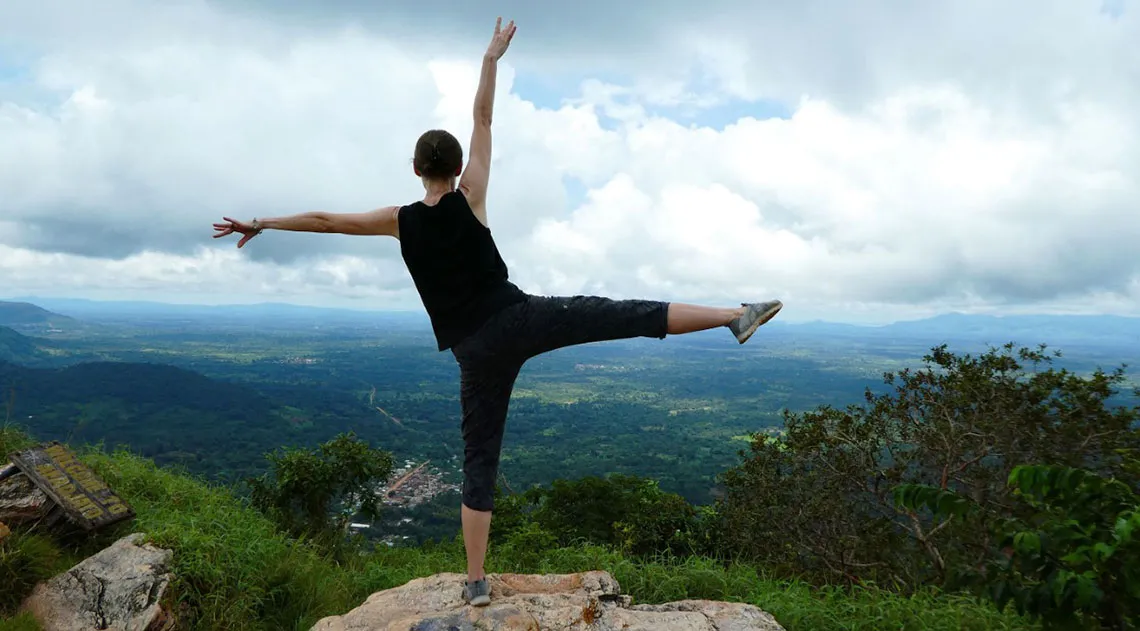
On top of the highest mountain in Ghana. Photo by Steve Weis.
Six Questions with Dr. Lisa Schrenk, Associate Professor of Architectural History
“As an architectural historian, my passion involves digging for the truth in order to achieve clearer and deeper understandings of the past to help produce better designs for the future.”
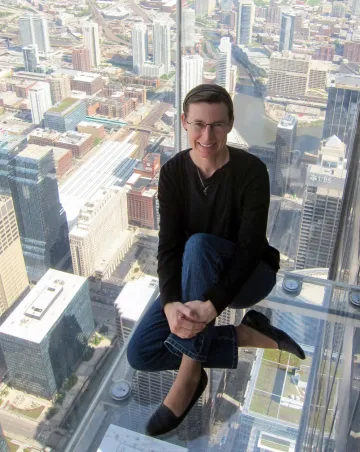
Above Chicago on "The Ledge" of the Sears/Willis tower.
What brought you to CAPLA?
I joined CAPLA in 2012 after teaching architecture and art history at Norwich University in Vermont for ten years. What brought me to CAPLA? A desire to escape snow!
What is your current research and what most excites you about these areas of focus?
As an architectural historian, my passion involves digging for the truth in order to achieve clearer and deeper understandings of the past to help produce better designs for the future. Often this means long days in archives toiling as a detective, carefully paging through box after box of dusty original records, photographs and architectural drawings and then trying to make sense of it all. Based on over 30 years of research, my new book, The Oak Park Studio of Frank Lloyd Wright (University of Chicago Press), dispels myths and corrects inaccuracies associated with Wright’s early career, revealing new insights into the operations of his early practice, including the numerous physical changes he made to the studio as he used it as an architectural laboratory.
My other main area research involves international expositions. My early projects focused on Chicago’s 1933-34 Century of Progress International Exposition, an incredibly significant event largely overlooked by 20th century architectural historians in the story of the rise of modern architecture in the United States. In more recent years my research on expositions has expanded to include other American world’s fairs of the 1930s and issues relating to the conditions of post-exposition fairgrounds. This later topic led to my involvement in Minnesota’s bids to host a future world’s fair. One of the facets of this research that excites me most is being able to use lessons from the past to help guide the designs of potential future expositions and involve CAPLA students in the process, including in past seminars connected to Minnesota’s efforts to host Expo 2023 and now Expo 2027.
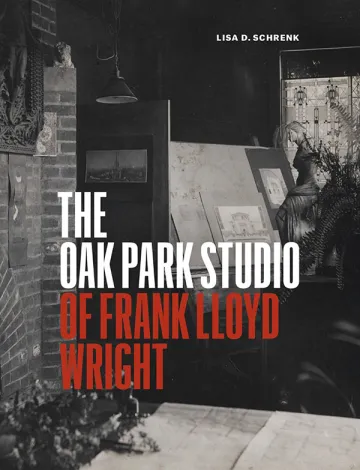
Available in April 2021 from the University of Chicago Press: The Oak Park Studio of Frank Lloyd Wright, by Lisa D. Schrenk.
What is your current service work, and what most excites you about this work?
While I have served in a wide range of university and professional positions, including on the Board of Directors for the Society of Architectural Historians and president of the Chicago Society of Architectural Historians, the service I most enjoy involves strengthening the student experience. I have been a UA Faculty Fellow since 2017 supporting students in the Historic Lane residence halls. In 2017 I also initiated and established the UArizona Women in Architecture Society (WIAS) with a group of third-year students. It has been really wonderful to help guide the meaningful work of this organization, including member participation in an exhibition I curated in 2019 that explored the impact of the Bauhaus on later generations of women architects in the United States.
Much of my CAPLA service activities involve envisioning and carrying out improvements to academic programs and the college community. This includes serving on CAPLA’s Council of Faculty Members and its Constitution and Bylaws Committee. I also contribute in similar ways to Semester at Sea (SAS) as a member of both their Faculty Council and the Governance task forces. SAS is an amazing study abroad program. Students spend a semester taking classes on a ship and visiting ports around the world. There is no better way to learn about world architecture than experiencing it! At UArizona I also serve on the Study Abroad Faculty Advisory Committee and the Acquisitions Committee for the University of Arizona Art Museum.
What are you currently teaching, and what do you most enjoy about teaching?
I typically teach survey courses on world architecture and seminars that tie to my research, including on Chicago architecture, International Expositions and Frank Lloyd Wright. This year I taught a new Introduction to Building Technology course. One of the things I enjoy most about teaching is engaging students in experiential learning and opening their eyes to the value of exploring architecture firsthand. In almost all of my courses there are assignments that take students out of the classroom. My seminars typically include related field trips to Phoenix or Chicago.
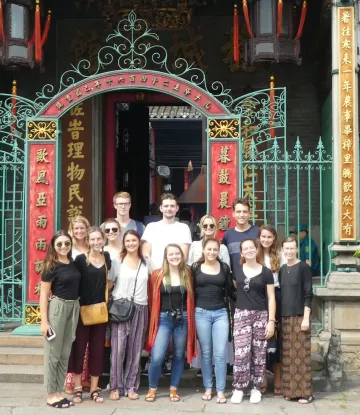
With SAS Sacred Space class at Thiên Hậu Temple in Saigon, Vietnam.
I recently presented a conference paper on how techniques borrowed from the fields of geography and art history can be used to develop skills in architecture students that allow them to examine and reflect upon the cultural conditions of built environments they encounter in meaningful ways. My interest in experiential learning led to participation in a recent curriculum project on the social agency of space with six other architectural historians from around the world, funded by a grant from the Global Architectural History Teaching Collaborative.
While COVID has made class trips difficult, students in my second-year survey course still were able to participate in an architectural scavenger hunt this past fall in which they were asked to photograph examples of different building elements and styles they found on campus or in their own neighborhoods. The assignment was enriched by international students in the class who, due to COVID, were taking the “live online” course at back at home in countries around the world, including Bahrain, Kazakhstan, Kuwait and Brazil. They shared photographs of fascinating examples from their communities.
Beyond research, teaching and practice, what are your passions?
One of my main passions is travel. I have visited over 85 countries and six continents, including Antarctica, though I’m still missing Australia. While it is not feasible to bring all of the students in my large UArizona world architecture courses to the many buildings we study in class, I am able to share with them many of my own photographs and experiences at the sites, helping to bring the architecture to life.
Another of my interests is Celtic dance. I was a premier Scottish Highland dancer and taught Highland dance off and on for many years. Shortly before I arrived in Arizona I expanded my interest to include Irish step dancing. More recently I’ve picked up my trumpet again after many years.
What does the CAPLA experience mean for you?
The CAPLA experience means engaging with others of different backgrounds, interests and perspectives to develop a deeper understanding of built environments and the cultures that create them.


