

Multidisciplinary Research Guides Teaching: Philip Stoker, Associate Professor of Landscape Architecture and Planning

Seven Questions with Philip Stoker, Assistant Professor of Landscape Architecture and Planning
“My experience conducting research on water sustainability, wildlife management, pedestrian safety, rural planning, commuting patterns and urban design guides my lectures and course design.”
What brought you to CAPLA?
I joined CAPLA in 2016 as a post-doctoral researcher to help develop the databases in CAPLA and teach GIS. After one semester I had the opportunity to transition to assistant professor and continue my research and teaching here.
What are your current research areas of focus?
In general, I am interested in how cities and neighborhoods can be designed and planned so that they have fewer negative environmental impacts. Specifically, I conduct research on how cities can be more water efficient. I am also interested in planning and development challenges in rural communities across the Intermountain West.
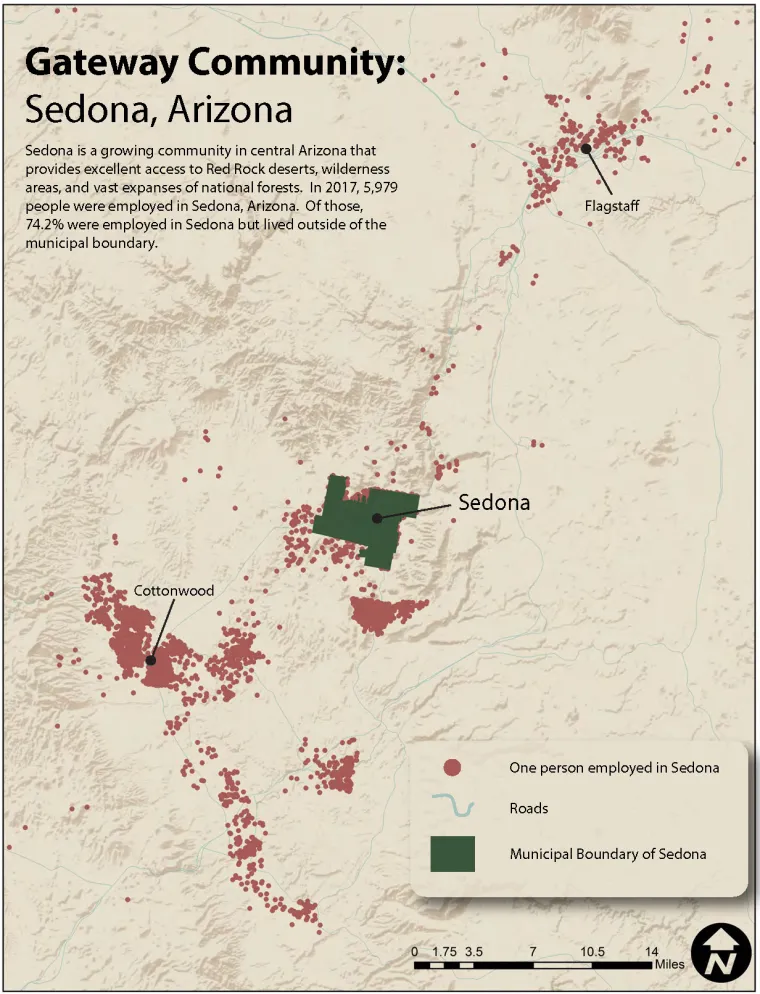
Map by Philip Stoker of people who commute to Sedona, Arizona, demonstrating that for "gateway communities" many people who work in the city commute from other locations.
What is your current service work, and what most excites you about this work?
I am most excited about working with students. I advise students in four programs across the University of Arizona: Urban Planning, Landscape Architecture, Sustainable Built Environments and Arid Lands Resource Sciences. I particularly enjoy helping them craft their own research projects.
Tell us about your consulting work outside of the University of Arizona.
I have been working as a consultant to a few different public utilities, where I enjoy conducting practical research that can improve their decision making. For example, I have partnered with the utilities to analyze customer consumption data, as well as forecast the viability of future infrastructure investments. I’m particularly delighted when the utilities reach out to hire my student research assistants after we have produced high-quality work for them.
What are you currently teaching, and what do you enjoy most about teaching?
I teach classes about geographical information systems (GIS) and mapping and sustainable development in cities. I also teach a research methods course in which students design their own research projects. I love teaching and it is the most fun part of my job. In my GIS class, I emphasize the importance of map design and communication and I always get excited when students surpass my own design and cartography abilities. All the students improve and that is very satisfying to see.
How do you bring your research into your teaching and student guidance?
My experience conducting research on water sustainability, wildlife management, pedestrian safety, rural planning, commuting patterns and urban design guides my lectures and course design. My research on this wide range of topics is also helpful when I advise students who are pursuing their own topics of interest. For instance, I might not be an expert on a topic that a student wants to pursue, but I would know how to help them design a research project so that they can become an expert.
Beyond your work at CAPLA and UArizona, what are your passions?
I love to go hiking and camping all over the Southwest. I bike to work every day and go for rides on the Loop. I play soccer on a team here in Tucson and love the CAPLA Cup—our own collegewide soccer tournament held each spring. I also play guitar, banjo, bass, drums, keyboard and harmonica and I’m working on my singing... so I love music too! My little dog Scraps is also just wonderful.
To learn more, view Philip Stoker's faculty page.


