

CAPLA’s Christopher Tucker Featured in 2025 Venice Biennale Installation
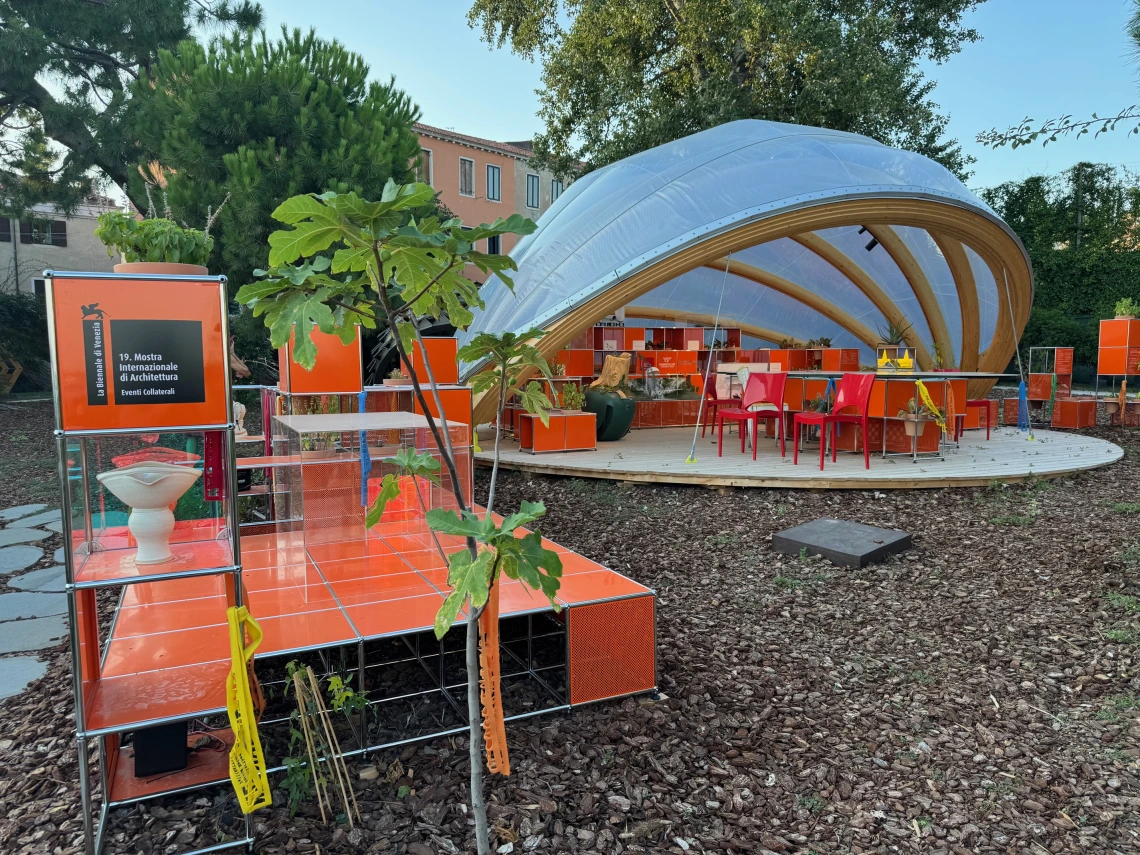
CAPLA Lecturer Chris Tucker contributed to three projects featured in Cloud 9 Architects’ pavilion at the 2025 Venice Biennale.
College of Architecture, Planning and Landscape Architecture (CAPLA) Lecturer Christopher Tucker was among the contributors to an international exhibition featured in the 2025 Venice Biennale, where his work was part of a collaborative installation exploring new directions in ecological design.
Tucker’s contributions were included in a pavilion developed by Cloud 9 Architects in collaboration with Virginia Tech. The exhibition was led by Enric Ruiz-Geli, founding architect of Cloud 9, who worked with students to design the pavilion. The installation featured nine projects, three of which—Villa Accretion, the ME WE Foundation, and The Watermill Center project—included significant contributions from Tucker.
Villa Accretion, a residential project located in Los Angeles County, highlighted an approach to architecture informed by biological and ecological systems. Drawing inspiration from the structure of oysters, the design pairs a soft interior with an exterior defined by folds and crevices that create opportunities for both human use and ecological habitat. The project emphasized integration with the surrounding landscape rather than imposition upon it.

“During my time with Cloud 9 Architects, I contributed to multiple design projects around the world,” Tucker said. “In the Villa Accretion project, we explored the form, biology, and ecology of oysters to develop a proposal that responded both to the client’s program and the site’s ecological conditions.”
Tucker said the inclusion of these projects in the Venice Biennale reflects a broader shift in architectural thinking toward more environmentally responsive design.
“It was exciting to see this project, among others, displayed at the Venice Biennale,” he said. “I believe the work we pursued expands the field of architecture by exploring how buildings can activate ecosystems and strengthen connections between humans and the environments we inhabit.”
He added that he hoped the exhibition encouraged visitors to reconsider conventional approaches to the built environment.
“I hope the work provokes visitors to imagine alternative ways of designing, building, and inhabiting place,” Tucker said. “I hope they see that architecture has the ability to empower both societal and ecological connections.”


