
Rethinking Infrastructure: Emily Miller '20 B.Arch
Aug. 12, 2020
Who
Emily Miller
What
Student Work | B Arch Capstone Project, Taught by Christopher Domin, Associate Professor of Architecture
Where
Seattle, Washington
When
2020
Image
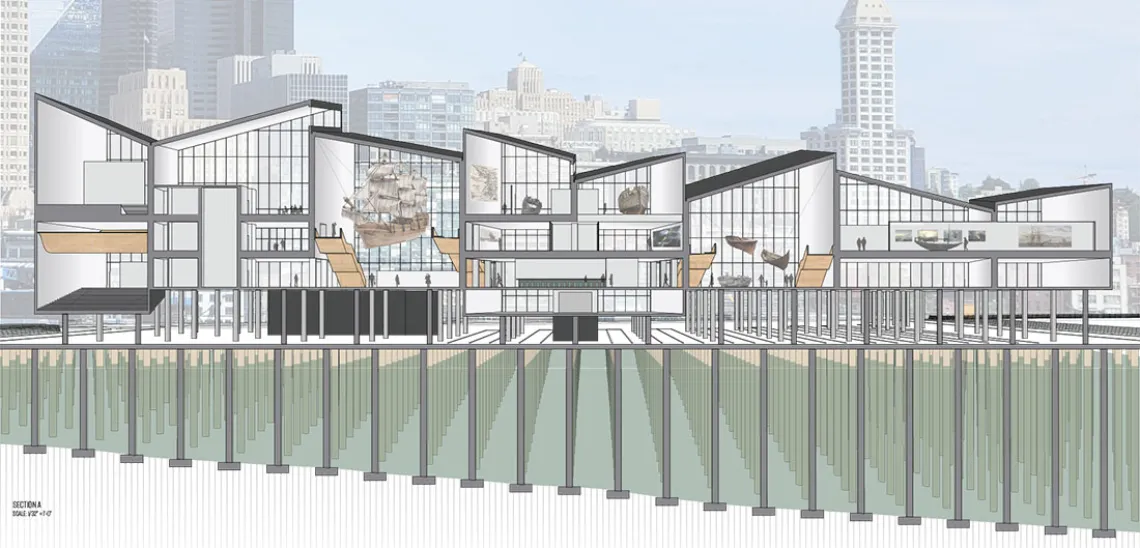
Rethinking Infrastructure, by Emily Miller

Seattle is at a pivotal point in its history, implementing massive change to its major transportation lines, while rethinking the complex flow and connection of pedestrians, bicyclists and vehicles. The Seattle waterfront is experiencing much of the current transformation, as it stands as a division between the idyllic condition of the islands to the west and the rapidly expanding city center to the east. The infrastructure of the waterfront is moving towards an inevitable shift in the function of its maritime piers, from industry to entertainment. The removal of the Alaskan Way Viaduct opened Alaskan Way for a new system of transportation—with new opportunities for utilizing the downtown waterfront. 

The newly envisioned Colman Dock stands between the industrial waterfront and the pedestrian waterfront, connecting users across Puget Sound and to the region's history. The Colman Ferry redevelopment includes a maritime museum and ferry terminal intertwined, creating a unique and meaningful engagement with Elliot Bay. Emily Miller’s project provides a space for the community to gather and learn, a ferry terminal which is vital to the infrastructure of Seattle and a glimpse into the rich history and culture of the area. The Colman Dock stands as a threshold between downtown Seattle and the bay, marking a point in history while commemorating the past.


Image Gallery

Click a thumbnail below to view a larger image and begin slideshow:


All images are by Emily Miller and may not be used or reproduced without express written permission of their creator.

Latest CAPLA News, Projects and Profiles

Image
Group photo of four CAPLA students who are members of the ISAPD

CAPLA to host Indigenous Design Symposium focused on community, sustainability

CAPLA’s Indigenous Society of Architecture, Planning and Design (ISAPD) will host an all-day symposium on April 6, bringing together students, faculty and practitioners to explore Indigenous approaches to the built environment. Featuring Indigenous designers and supported by campus partners, the event will highlight community-centered design, sustainability and the role of Indigenous knowledge systems in shaping more responsible relationships with land.

Image
Six students and faculty work together to lift the frame of a wall for a house they are building in Agua Prieta

CAPLA students build housing in Agua Prieta during spring break

CAPLA students spent spring break in Agua Prieta, Sonora, building a home for a local family in partnership with Rancho Feliz. Working alongside community members, they gained hands-on construction experience while contributing to a reciprocal housing program designed to address affordability and climate-responsive design.

Image
Jackie Hogan Headshot

Research-Based Approach to Architecture: Jackie Hogan M.Arch + MS.Arch ‘25

Jackie Hogan (’25 M.Arch + MS.Arch) is a dual-degree graduate of CAPLA whose work bridges architectural practice and research-driven design. Drawn to architectural history, theory and ethics, she pursued the M.Arch + MS.Arch dual degree to explore how research can shape meaningful design decisions. During her time at CAPLA, she engaged in community-centered design through Laura Carr’s studio working with the Tuba City community and completed a thesis examining architecture’s role in disaster relief and climate-related emergencies. Now working at Line + Space, Hogan brings an evidence-based approach to projects, applying research to create thoughtful spaces that connect people, culture and the environment.