


A Love Letter to the U of A: Laura Vertes Designs the Wildcat Welcome Center
For many, the journey to becoming a Wildcat begins before they ever set foot in a classroom. It might start with a campus tour, a conversation with a student ambassador or a glimpse of Old Main. The Wildcat Welcome Center opened on Wednesday, Sept. 9, and has officially become a cornerstone of that experience.

Philip Stoker Leads Effort to Modernize Lake Tahoe’s Sustainable Recreation Plan
For decades, the Lake Tahoe Basin has worked to balance preserving the region’s renowned natural beauty and recreational opportunities with accommodating the millions of visitors and growing communities drawn to the area. A team of researchers from the University of Arizona, University of Utah and Vancouver Island University is taking on that challenge through a two-year, $350,000 project to modernize Lake Tahoe’s sustainable recreation goals.

Brendan Shea receives Envision Resilience award to support climate adaptation studio
Brendan Shea, assistant professor of practice in CAPLA’s School of Architecture, received a National Design Studio Award from Envision Resilience to support a Spring 2026 studio focused on climate adaptation in the Colorado River Watershed.

Teresa Rosano receives AIAS Faculty Advisor Honor Award
Teresa Rosano, associate professor at the School of Architecture, earned the 2025 AIAS Faculty Advisor Honor Award for her mentorship, inclusive teaching, and leadership. She inspires students through community-focused, real-world architectural education and over 25 years of professional experience.

A Force to be Reckoned With: Francisco Zazueta ‘26 B.Arch
Francisco Zazueta, a fifth-year Bachelor of Architecture student at CAPLA, was awarded the 2025 Presidential Citation by the AIA Southern Arizona Chapter for his leadership as president of the AIA Student Chapter. Recognized for his optimism and dedication to strengthening connections between students and professionals, his work focuses on mentorship, community engagement, and expanding opportunities for architecture students. Through initiatives with NOMAS and AIAS, Zazueta uses leadership and design to support a more connected, just, and resilient architectural community.

Professor Beth Weinstein Promotes Book in Europe
Professor Beth Weinstein has been promoting her 2024 book on collaborations between architects and choreographers across Europe while researching the Centre d’Identification de Vincennes (CIV), a former internment site in Paris. Her work combines archival methods and community engagement through lectures, walks, and publications, aiming to raise awareness and achieve official recognition of the CIV as a memorial site.

Gather Light: ARC 201
Students in CAPLA’s ARC 201 studio, guided by faculty including Christopher Domin and others, completed the "Gather Light" project focused on understanding and designing in harmony with the Sonoran Desert environment. Through observation, drawing, and modeling, students explored how light, nature, and architecture interact. Key activities involved studying desert plants, translating their forms into design systems, and developing canopies that filter light and enhance outdoor spaces. The project emphasized hands-on learning, teamwork, and iterative design using 2D and 3D representations to create thoughtful architectural interventions that respect and respond to the desert landscape.

Lecturer Christopher Tucker wins AIA Design Pedagogy Award for innovative Abiotic Studio
Christopher Tucker, a lecturer in architecture at CAPLA, received the American Institute of Architects’ Design Pedagogy Award for his Abiotic Studio, a fourth-year course that challenges students to engage with ecological realities and reimagine post-industrial landscapes through more-than-human perspectives.
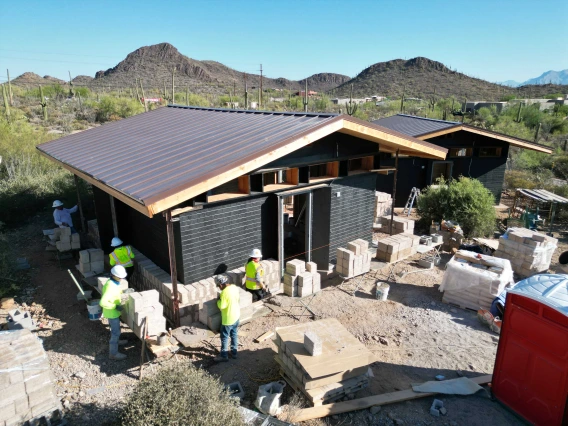
Transforming Cooper Center Cabins Through Sustainable Design
CAPLA students, alumni and faculty are redesigning the Cooper Center’s aging cabins to create more sustainable, student-friendly spaces.

Jesus Robles Showcases Tucson-Inspired Work at the Venice Biennale
Jesus Robles, an Assistant Professor of Practice and co-founder of the architecture studio DUST, was selected to showcase Tucson-inspired work at the 2025 Venice Architecture Biennale, one of the world’s leading platforms for design innovation.

Alumna Helen J. Kessler ’75 establishes travel fellowship endowment to expand learning opportunities
The Helen J. Kessler, FAIA International Travel Fellowship will provide CAPLA students with transformative international learning experiences. Kessler ’75 B.Arch created the endowment to share the impact that global travel and study had on her own career.